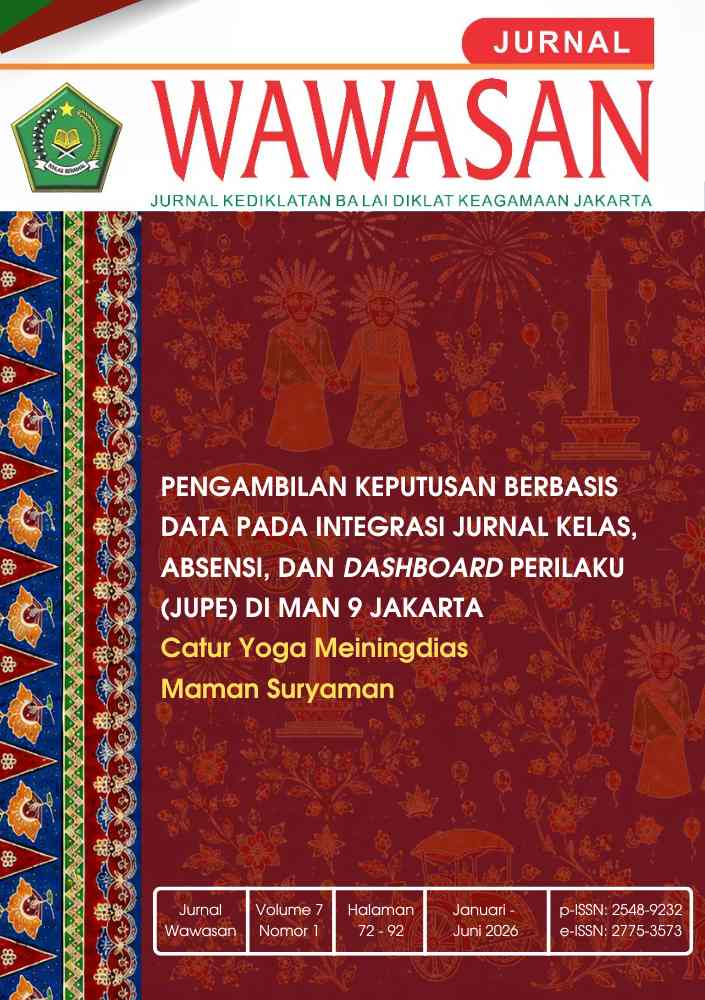
PENGAMBILAN KEPUTUSAN BERBASIS DATA PADA INTEGRASI JURNAL KELAS, ABSENSI, DAN DASHBOARD PERILAKU (JUPE) DI MAN 9 JAKARTA
DOI:
https://doi.org/10.53800/a580zg95Keywords:
data-driven decision making, integrated class journal, attendance, behavior dashboard, restorative practice, jurnal kelas terintegrasi, kehadiran periodik, dashboard perilaku, praktik restoratifAbstract
Abstract
The management of daily student data in madrasahs is often fragmented and handled manually, hindering rapid responses to on-the-ground issues. There is an operational gap: existing systems have not been able to integrate academic and behavioral data to generate real-time strategic insights. To bridge this gap, this qualitative case study examines how the Integrated Class Journal, Attendance, and Behavior Dashboard (JUPE) facilitates Data-Driven Decision Making (DDDM) at MAN 9 Jakarta. Methodologically, this research applies a qualitative approach with a case study design. Data collection involved 16 informants through interviews, observations, and document studies, and the data were analyzed using a hybrid of thematic analysis and process tracing. The main finding is that decision-making consistently relies on three data streams: learning records, attendance trends, and behavioral profiles. This integration shortens response times, increases the perception of procedural justice, and enables restorative pathways tailored to root causes. There are three main drivers of this implementation's success: minimum evidentiary standards, micro-professional development, and user-centered dashboard design. This study contributes to the development of a DDDM operational model that integrates academic and behavioral data to align with restorative practices.
Abstrak
Pengelolaan data harian siswa di lingkungan madrasah sering kali masih terfragmentasi dan dikelola secara manual, sehingga menghambat respons yang cepat terhadap kendala di lapangan. Terdapat kesenjangan operasional di mana sistem yang ada belum mampu mengintegrasikan data akademik dan perilaku menjadi wawasan strategis secara real-time. Untuk menjembatani masalah tersebut, studi kasus kualitatif ini mengkaji bagaimana Dashboard Jurnal Kelas Terintegrasi, Kehadiran, dan Perilaku (JUPE) memfasilitasi Data-Driven Decision Making (DDDM) di MAN 9 Jakarta. Secara metodologis, penelitian ini menggunakan pendekatan kualitatif dengan desain studi kasus. Pengumpulan data melibatkan 16 informan melalui teknik wawancara, observasi, dan studi dokumen, yang kemudian dianalisis menggunakan analisis tematik hibrida dan penelusuran proses. Temuan menunjukkan bahwa proses pengambilan keputusan secara konsisten berpijak pada tiga aliran data: catatan pembelajaran, tren kehadiran, dan profil perilaku. Integrasi ini menghasilkan waktu respons yang lebih singkat serta meningkatkan persepsi keadilan prosedural. Jalur restoratif juga disesuaikan dengan akar masalah yang telah teridentifikasi. Terdapat tiga pendorong utama keberhasilan implementasi ini, yaitu standar bukti minimum, pengembangan profesional mikro, dan desain dashboard yang berpusat pada pengguna. Studi ini berkontribusi dalam penyediaan model operasional DDDM yang memadukan data akademik dan perilaku agar selaras dengan praktik restoratif.
Downloads
References
Adams, C., Adigun, O., Fiegener, A., & Olsen, J. (2023). Transformative leadership conversation: a conceptualization and empirical test of its function. Journal of Educational Administration, 61(5), 531–546. https://doi.org/https://doi.org/10.1108/jea-10-2022-0190
Banoğlu, K., Vanderlinde, R., Çetin, M., & Aesaert, K. (2022). Role of school principals’ technology leadership practices in building a learning organization culture in public K-12 schools. Journal of School Leadership, 33(1), 66–91. https://doi.org/https://doi.org/10.1177/10526846221134010
Baradaran, A., Tolentino, R., Grad, R., Ganache, I., Gore, G., Rahimi, S., & Pluye, P. (2024). Outcomes of guidelines from health technology assessment organizations in community-based primary care: a systematic mixed studies review. International Journal of Technology Assessment in Health Care, 40(1). https://doi.org/https://doi.org/10.1017/s0266462324000370
Baran, E., AlZoubi, D., & Morales, A. (2023). Design and implementation of an automated classroom analytics system: Stakeholder engagement and mapping. TechTrends, 67(6), 945–954. https://doi.org/https://doi.org/10.1007/s11528-023-00905-2
Bertrand, M., & Marsh, J. (2021). How data-driven reform can drive deficit thinking. Phi Delta Kappan, 102(8), 35–39. https://doi.org/https://doi.org/10.1177/00317217211013936
Brazauskienė, E., & Melnikova, J. (2024). Data literacy of secondary school teachers: The competence-based approach. Regional Formation and Development Studies, 17–27. https://doi.org/https://doi.org/10.15181/rfds.v42i1.2608
Campos, F., Nguyen, H., Ahn, J., & Jackson, K. (2023). Leveraging cultural forms in human-centered learning analytics design. British Journal of Educational Technology, 55(3), 769–784. https://doi.org/https://doi.org/10.1111/bjet.13384
Chen, I., & Phanumartwiwath, A. (2025). Community and identity: how repair cafés promote well-being and social engagement among older men? Australasian Journal on Aging, 44(2). https://doi.org/https://doi.org/10.1111/ajag.70041
Comstock, M., & Margolis, J. (2020). “Tearing down the wall”: making sense of teacher leaders as instructional coaches and evaluators. Journal of School Leadership, 31(4), 297–317. https://doi.org/https://doi.org/10.1177/1052684620969932
Curran, F. C., Carlo, S., & Harris-Walls, K. (2024). Making the data visible: A systematic review of systems-level data dashboards for leadership and policy in education. Review of Educational Research. https://doi.org/https://doi.org/10.3102/00346543241288249
Darling-Hammond, S., Ruiz, M., Eberhardt, J., & Okonofua, J. (2023). The dynamic nature of student discipline and discipline disparities. Proceedings of the National Academy of Sciences, 120(17), e2120417120. https://doi.org/https://doi.org/10.1073/pnas.2120417120
Demirkasımoğlu, N., & DİŞ, O. (2025). The key role of communication in principals’ sensemaking competencies in enhancing school effectiveness. Psychology in the Schools. https://doi.org/https://doi.org/10.1002/pits.70087
Dodman, S., DeMulder, E., View, J., Stribling, S., & Brusseau, R. (2023). “I knew it was a problem before, but did I really?”: Engaging teachers in data use for equity. Journal of Educational Change, 24(4), 995–1023. https://doi.org/https://doi.org/10.1007/s10833-022-09477-z
Doğan, E. (2023). A meta-analysis study on data literacy education for school administrators and teachers. Kuramsal Eğitimbilim, 16(1), 199–217. https://doi.org/https://doi.org/10.30831/akukeg.1134207
Eppard, J., Kaviani, A., Bowles, M., & Johnson, J. (2021). EdTech culturation: integrating a culturally relevant pedagogy into educational technology. The Electronic Journal of E-Learning, 19(6), 516–530. https://doi.org/https://doi.org/10.34190/ejel.19.6.2065
Ford, D., & Hines, E. (2025). An overview of instructional violence: promoting culturally responsive instruction. Gifted Child Today, 48(3), 221–226. https://doi.org/https://doi.org/10.1177/10762175251330327
Goffin, E., Janssen, R., & Vanhoof, J. (2022). Teachers’ and school leaders’ sensemaking of formal achievement data: a conceptual review. Review of Education, 10(1). https://doi.org/https://doi.org/10.1002/rev3.3334
Gottfried, M., Kirksey, J., & Ozuna, C. (2020). Exploring the links between student and classmate chronic absenteeism. Teachers College Record, 122(12), 1–28. https://doi.org/https://doi.org/10.1177/016146812012201205
Gregory, A., Huang, F., & Ward-Seidel, A. (2024). Adolescent exposure to restorative practices and their perceptions of support, structure, and bullying in the school climate. AERA Open, 10. https://doi.org/https://doi.org/10.1177/23328584241288525
Herro, D., Madison, M., Irgens, G., Hirsch, S., Abimbade, O., & Adisa, O. (2022). Exploring elementary teachers’ perceptions of data science and curriculum co-design through professional development. Journal of Technology and Teacher Education, 30(4), 493–525. https://doi.org/https://doi.org/10.70725/525425phybup
Jagupit, M. A., Fedelis, J., Camingao, A., Lacuña, M., & Japitana, R. (2020). The implementation of the daily lesson log in the central schools of the Buenavista District. SHERJ, 2(1). https://doi.org/https://doi.org/10.18868/cte.02.060120.13
Johnson, S., Kulkarni, N., Jesús, S., Cottam, S., Fillhouer, M., & Guevara, A. (2024). School‐family partnerships to support attendance: Advancing an equity‐centered theoretical framework. Journal of School Health, 94(8), 777–785. https://doi.org/https://doi.org/10.1111/josh.13457
Karia, M., Abouharb, A., Sabharwal, S., Mavroveli, S., & Cobb, J. (2025). Impact of bone quality on surgical decision-making in total hip arthroplasty: a qualitative analysis in the UK. BMJ Open, 15(1), e088081. https://doi.org/https://doi.org/10.1136/bmjopen-2024-088081
Khosravi, H., Shabaninejad, S., Bakharia, A., Sadiq, S., Indulska, M., & Gašević, D. (2021). Intelligent learning analytics dashboards: Automated drill-down recommendations to support teacher data exploration. Journal of Learning Analytics, 8(3), 133–154. https://doi.org/https://doi.org/10.18608/jla.2021.7279
Kovanović, V., Mazziotti, C., & Lodge, J. (2021). Learning analytics for primary and secondary schools. Journal of Learning Analytics, 8(2), 1–5. https://doi.org/https://doi.org/10.18608/jla.2021.7543
Ličen, S., Karnjuš, I., & Prosen, M. (2020). Measuring cultural awareness among Slovene nursing students: a cross-sectional study. Journal of Transcultural Nursing, 32(1), 77–85. https://doi.org/https://doi.org/10.1177/1043659620941585
Lodi, E., Perrella, L., Lepri, G., Scarpa, M., & Patrizi, P. (2021). Use of restorative justice and restorative practices at school: a systematic literature review. International Journal of Environmental Research and Public Health, 19(1), 96. https://doi.org/https://doi.org/10.3390/ijerph19010096
Longmuir, F. (2021). Leading in lockdown: community, communication, and compassion in response to the COVID-19 crisis. Educational Management Administration & Leadership, 51(5), 1014–1030. https://doi.org/https://doi.org/10.1177/17411432211027634
Lowell, B., Fogelman, S., & McNeill, K. (2024). Organizational sensemaking during curriculum implementation: the dilemma of agency, role of collaboration, and importance of discipline-specific leadership. Science Education, 108(5), 1448–1473. https://doi.org/https://doi.org/10.1002/sce.21885
Maryani, L., Nur, J., Utami, S., Nurnaifah, I., & Farida, F. (2023). Strengthening school management with digital education technology to improve the quality of educational output. Indonesian Journal of Educational Research and Review, 6(2), 446–465. https://doi.org/https://doi.org/10.23887/ijerr.v6i2.66039
McIntosh, K., Girvan, E., Falcon, S., McDaniel, S., Smolkowski, K., Bastable, E., & Baldy, T. (2021). Equity-focused PBIS approach reduces racial inequities in school discipline: A randomized controlled trial. School Psychology, 36(6), 433–444. https://doi.org/https://doi.org/10.1037/spq0000466
McIntosh, K., Smolkowski, K., Gion, C., Witherspoon, L., Bastable, E., & Girvan, E. (2020). Awareness is not enough: A double-masked randomized controlled trial of the effects of providing discipline disproportionality data reports to school administrators. Educational Researcher, 49(7), 533–537. https://doi.org/https://doi.org/10.3102/0013189x20939937
Mehrolhassani, M., Jahromi, V., Dehnavieh, R., & Iranmanesh, M. (2021). Underlying factors and challenges of implementing the urban family physician program in Iran. BMC Health Services Research, 21(1). https://doi.org/https://doi.org/10.1186/s12913-021-07367-3
Michaeli, S., Kroparo, D., & Hershkovitz, A. (2020). Teachers’ use of education dashboards and professional growth. The International Review of Research in Open and Distributed Learning, 21(4), 61–78. https://doi.org/https://doi.org/10.19173/irrodl.v21i4.4663
Naidoo, V., Stewart, A., & Maleka, M. (2023). The development of items for a physiotherapy clinical program evaluation tool. South African Journal of Physiotherapy, 79(1). https://doi.org/https://doi.org/10.4102/sajp.v79i1.1908
Nakamura, K., Horikoshi, I., Majumdar, R., & Ogata, H. (2024). Extract instructional process from xAPI log data: A case study in Japanese junior high school. Research and Practice in Technology Enhanced Learning, 20, 013. https://doi.org/https://doi.org/10.58459/rptel.2025.20013
Otten, R., Faughnan, M., Flattley, M., & Fleurinor, S. (2021). Integrating equity, diversity, and inclusion into social innovation education: a case study of critical service-learning. Social Enterprise Journal, 18(1), 182–200. https://doi.org/https://doi.org/10.1108/sej-11-2020-0101
Shamsuddin, F., & Razak, A. (2023). Development of a model for data-driven decision making: Critical skills for school leaders. Malaysian Journal of Social Sciences and Humanities (MJSSH), 8(12), e002614. https://doi.org/https://doi.org/10.47405/mjssh.v8i12.2614
Siregar, N., Putri, F., Saputri, V., & Sakunti, S. (2023). Kendala dalam mengimplementasikan jurnal reflektif sebagai bentuk profesionalisme guru di MI. Journal on Education, 5(2), 1656–1662. https://doi.org/https://doi.org/10.31004/joe.v5i2.801
Sušnjak, T., Ramaswami, G., & Mathrani, A. (2022). Learning analytics dashboard: A tool for providing actionable insights to learners. International Journal of Educational Technology in Higher Education, 19(1), 1–28. https://doi.org/https://doi.org/10.1186/s41239-021-00313-7
Sutherland, R., Campbell, E., McLaughlin, M., Nathan, N., Wolfenden, L., Lubans, D., & Wiggers, J. (2020). Scale-up of the Physical Activity 4 Everyone (PA4E1) intervention in secondary schools: 12-month implementation outcomes from a cluster randomized controlled trial. International Journal of Behavioral Nutrition and Physical Activity, 17(1). https://doi.org/https://doi.org/10.1186/s12966-020-01000-y
Welsh, R., & Sobti, N. (2023). Moving from pathology to politicized care: Examining Black school leaders’ perspectives on school discipline. Journal of School Leadership, 33(6), 579–606. https://doi.org/https://doi.org/10.1177/10526846231174153
Wiley, K., Dimitriadis, Y., & Linn, M. (2023). A human-centered learning analytics approach for developing contextually scalable K‐12 teacher dashboards. British Journal of Educational Technology, 55(3), 845–885. https://doi.org/https://doi.org/10.1111/bjet.13383
Wulandari, D. (2022). Bullying prevention and intervention in schools: Implications of participatory action research. International Journal of Social Science and Human Research, 05(04). https://doi.org/https://doi.org/10.47191/ijsshr/v5-i4-13
Zeng, L. (2024). Self-efficacy of data literacy among primary and secondary school teachers in Guangdong Province. Journal of Education Studies, 20(2), 2113–2125. https://doi.org/https://doi.org/10.52783/jes.1661
Published
Issue
Section
License
Copyright (c) 2026 Wawasan: Jurnal Kediklatan Balai Diklat Keagamaan Jakarta

This work is licensed under a Creative Commons Attribution-ShareAlike 4.0 International License.