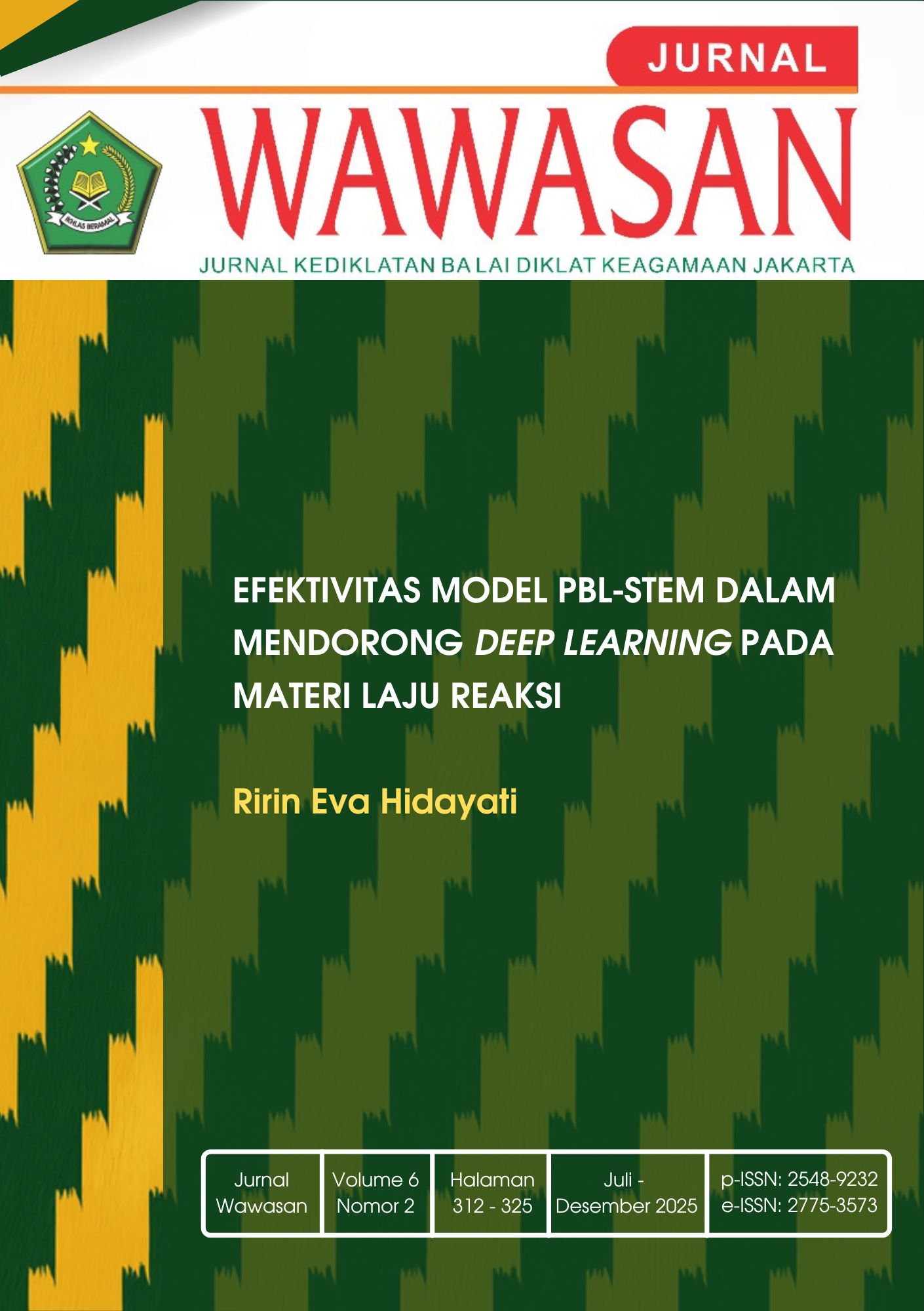
EFEKTIVITAS MODEL PBL-STEM DALAM MENDORONG DEEP LEARNING PADA MATERI LAJU REAKSI
DOI:
https://doi.org/10.53800/e1qwg378Keywords:
deep learning, kuasi eksperimen, laju reaksi, PBL-STEM, pembelajaran kimia, chemistry learning, quasi-experiment, reaction rateAbstract
Students’ understanding of reaction rate concepts in madrasah aliyah remains low due to learning practices that emphasize rote memorization rather than critical and practical thinking. This paper explores the effectiveness of applying the Problem-Based Learning model in conjunction with STEM principles in fostering deep learning among students on the topic of reaction rates. This study employed a quasi-experimental, nonequivalent control-group design. This study involved 68 students from MAN 1 Kota Malang, with 34 assigned to the experimental group (class XI-G) and 34 to the control group (class XI-F). Data collection involved pretests and posttests comprising five-option multiple-choice questions, as well as classroom observations and analysis of student reflection journals. The findings revealed a notable disparity in academic performance between the treatment and comparison groups. The treatment group achieved an average posttest score of 77.33, with an N-Gain of 0.58, placing it in the moderate category. In contrast, the comparison group obtained an average score of 56.67, with a lower N-Gain of 0.28, which was categorized as low. Observational and reflective data indicated that learners in the treatment group were more active, collaborative, and able to transfer concepts to real-world contexts. A key innovation of this study is the structured implementation of the PBL-STEM model, which not only improves cognitive achievement but also fosters deep learning through contextual learning experiences, collaborative projects, and reflective thinking. This model proves to be effective in chemistry instruction aligned with the Merdeka Curriculum.
Abstrak
Pemahaman siswa terhadap materi laju reaksi di madrasah aliyah masih tergolong rendah karena pembelajaran cenderung berfokus pada hafalan rumus tanpa memberikan ruang untuk berpikir kritis dan aplikatif. Tujuan dari penelitian ini adalah untuk mengevaluasi seberapa efektif penerapan model pembelajaran Problem Based Learning yang terintegrasi dengan pendekatan STEM pada pembelajaran mendalam (deep learning) siswa pada topik laju reaksi. Metode yang digunakan dalam penelitian ini adalah kuasi eksperimen dengan desain Nonequivalent Control Group. Sampel penelitian mencakup siswa kelas XI di MAN 1 Kota Malang, dengan XI-F sebagai kelas kontrol dan XI-G sebagai kelas eksperimen, masing-masing berjumlah 34 siswa.Data dikumpulkan melalui pemberian pretest dan posttest dalam bentuk soal pilihan ganda lima opsi, serta melalui teknik observasi dan penulisan jurnal refleksi. Penelitian ini menemukan perbedaan nyata dalam capaian pembelajaran antara kelas eksperimen dan kontrol. Nilai rerata posttest kelas eksperimen adalah 77,33 dengan peningkatan N-Gain 0,58 (kategori sedang), sementara kelas kontrol menunjukkan rata-rata 56,67 dan N-Gain 0,28 (kategori rendah). Data observasi dan refleksi memberi gambaran bahwasanya siswa pada kelompok eksperimen lebih aktif, kolaboratif, dan mampu mentransfer konsep ke situasi nyata. Kebaruan dari penelitian ini terletak pada penerapan sistematis langkah-langkah PBL-STEM yang tidak hanya meningkatkan capaian kognitif, tetapi juga membentuk proses deep learning melalui pengalaman belajar kontekstual, proyek kolaboratif, dan refleksi mendalam. Model ini efektif diterapkan dalam pembelajaran kimia berbasis Kurikulum Merdeka.
Downloads
References
Arisa, S., & Sitinjak, D. S. (2022). Implementation of the STEM-PBL Approach in Online Chemistry Learning and its Impact on Students’ Critical Thinking Skills. Jurnal Pendidikan Kimia Indonesia, 6(2), 88–96. https://doi.org/10.23887/jpki.v6i2.44317
Byusa, E., Kampire, E., & Mwesigye, A. R. (2022). Game-based learning approach on students’ motivation and understanding of chemistry concepts: A systematic review of literature. Heliyon, 8(5), e09541. https://doi.org/10.1016/j.heliyon.2022.e09541
Fareza, F. S., Van Hayus, E. S., Ari Syahidul Shidiq, Sri Yamtinah, Mohammad Masykuri, Maria Ulfa, … Bakti Mulyani. (2024). Problem-Based Learning Model on Students’ Chemical Literacy and Critical Thinking on Reaction Rate Material. JPI (Jurnal Pendidikan Indonesia), 13(3), 426–435. https://doi.org/10.23887/jpiundiksha.v13i3.79331
Fitriani, A., & Santiani. (2025). Analisis Literatur: Pendekatan Pembelajaran Deep learning dalam Pendidikan. Jurnal Ilmiah Nusantara (JINU), 2(3), 50–57. Retrieved from https://doi.org/10.61722/jinu.v2i3.4357
Gunawan, H. S., Maylia, E. C., Amelia, A. P., & Anasta, N. D. C. (2025). Project-Based Learning ( PBL ) Model in Improving Critical Thinking of Elementary School Students in Indonesian Language Learning. Jurnal Review Pendidikan Dasar: Jurnal Kajian Pendidikan Dan Hasil Penelitian, 11(1), 86–100.
Herlinawati, H., Marwa, M., Ismail, N., Junaidi, Liza, L. O., & Situmorang, D. D. B. (2024). The integration of 21st century skills in the curriculum of education. Heliyon, 10(15), e35148. https://doi.org/10.1016/j.heliyon.2024.e35148
Jelita, J., & Nuraida, N. (2023). The Effect of a Scientific Approach Based on Problem Based Learning Models on Students Science Problem Solving Skills at Madrasah Ibtidaiyah. Jurnal Pendidikan Sains Indonesia, 11(4), 755–766. https://doi.org/10.24815/jpsi.v11i4.31734
Jumhur, A. A., Avianti, R. A., Nurfitri, P. E., & Mahir, I. (2024). Implementation of Problem-based Learning to Improve Critical Thinking Ability of Vocational Students in Jakarta. European Journal of Education and Pedagogy, 5(5), 16–24.
Kusumadani, A. I., Affandy, H., Sunarno, W., Suryana, R., & Andiena, R. Z. (2024). Novel Approach in Enhanching Science Education Through Problem-Based Creative Learning and Delphi Evaluation. Jurnal Pendidikan IPA Indonesia, 13(4), 668–679. https://doi.org/10.15294/jpii.v13i4.852
Langitasari, I., & Robandi, B. (2023). Analysis of The Student’s Ability to Interconnect Macro-Submicro-Symbolic Representation on Electrolyte Solution Concept. EduChemia (Jurnal Kimia Dan Pendidikan), 8(1), 84. https://doi.org/10.30870/educhemia.v8i1.19974
Liu, Y., & Pásztor, A. (2022). Effects of problem-based learning instructional intervention on critical thinking in higher education: A meta-analysis. Thinking Skills and Creativity, 45(December 2021). https://doi.org/10.1016/j.tsc.2022.101069
Miller, E. C., & Krajcik, J. S. (2019). Promoting deep learning through project-based learning: a design problem. Disciplinary and Interdisciplinary Science Education Research, 1(1), 1–10. https://doi.org/10.1186/s43031-019-0009-6
Rehman, N., Huang, X., Mahmood, A., AlGerafi, M. A. M., & Javed, S. (2024). Project-based learning as a catalyst for 21st-Century skills and student engagement in the math classroom. Heliyon, 10(23), e39988. https://doi.org/10.1016/j.heliyon.2024.e39988
Sari, W. K., Supriatna, A., & Hendayana, S. (2019). Analysis of students difficulties based on respondents ability test on the topic of factors affecting reaction rate. Journal of Physics: Conference Series, 1157(4), 1–7. https://doi.org/10.1088/1742-6596/1157/4/042032
Sofiatunnisa, U., & Adirakasiwi, A. G. (2025). Analysis of Students ’ Ability To Identify Symbolic. EMTEKA: Jurnal Pendidikan Matematika, 6(1), 7–10.
Tairas, N., Rohaeti, E., Prodjosantoso, A. K., Ikhsan, J., & Ningthias, D. P. (2025). STEM-Integrated Problem-Based Learning in Green Chemistry to Enhance Chemical Literacy and Scientific Attitudes. Jurnal Penelitian Pendidikan IPA, 11(3), 615–626. https://doi.org/10.29303/jppipa.v11i3.10666
Tong, D. H., Uyen, B. P., & Ngan, L. K. (2022). The effectiveness of blended learning on students’ academic achievement, self-study skills and learning attitudes: A quasi-experiment study in teaching the conventions for coordinates in the plane. Heliyon, 8(12), e12657. https://doi.org/10.1016/j.heliyon.2022.e12657
Wati, P., Nusantara, T., & Utama, C. (2024). Efektivitas PjBL-STEM Terhadap Keterampilan Berpikir Kritis dan Motivasi Belajar Siswa Sekolah Dasar. Cetta: Jurnal Ilmu Pendidikan, 7(2), 126–143. https://doi.org/10.37329/cetta.v7i2.3264
Published
Issue
Section
License
Copyright (c) 2025 Wawasan: Jurnal Kediklatan Balai Diklat Keagamaan Jakarta

This work is licensed under a Creative Commons Attribution-ShareAlike 4.0 International License.