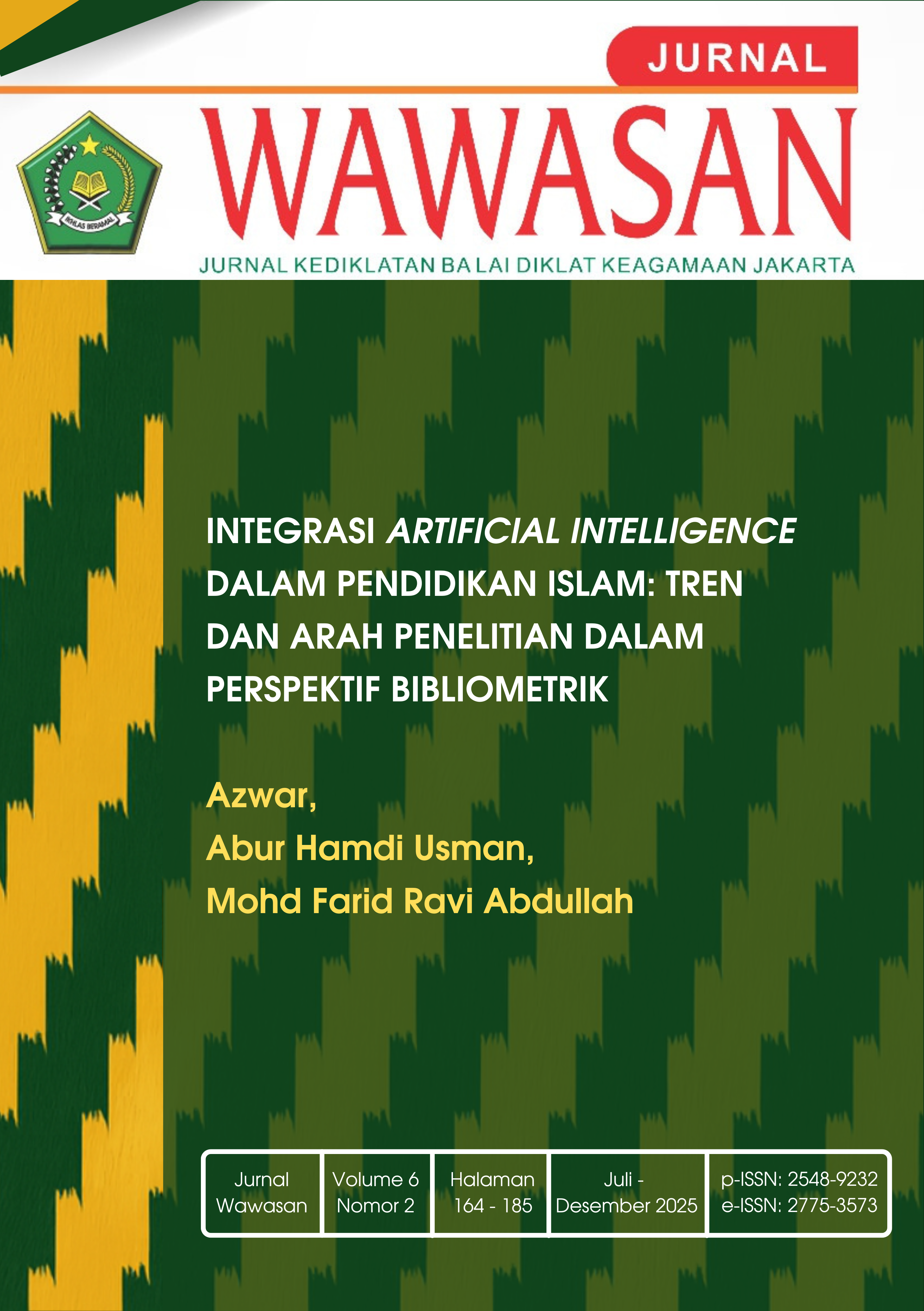
INTEGRASI ARTIFICIAL INTELLIGENCE DALAM PENDIDIKAN ISLAM: TREN DAN ARAH PENELITIAN DALAM PERSPEKTIF BIBLIOMETRIK
DOI:
https://doi.org/10.53800/n3wtx409Keywords:
artificial intelligence, Islamic education, bibliometric, kecerdasan buatan, pendidikan islam, bibliometrikAbstract
This study aims to provide a comprehensive understanding of the development and research direction regarding the integration of Artificial Intelligence (AI) in Islamic education. It focuses on analyzing and mapping publication trends, researcher collaboration, institutional contributions, and dominant and underexplored topics. Using a bibliometric approach, the study draws on data from the Scopus database for the period 2015 to 2025. The findings reveal a significant increase in publication volume in recent years, with Indonesia emerging as the leading contributor, alongside institutions such as Universiti Kebangsaan Malaysia, International Islamic University Malaysia, and UIN Sunan Gunung Djati. Key contributors and the most influential works were identified, with Taufik M.’s article recognized as the most cited. Keyword mapping shows that research in this field centers on themes such as learning, models, approaches, and educational processes, with emerging trends including machine learning and AI-based evaluation. Several low-density topics, such as Islamic perspectives and deep understanding, indicate promising areas for future research. This study offers a valuable contribution to understanding the evolving scholarly landscape at the intersection of intelligent technology and Islamic educational values.
Abstrak
Penelitian ini bertujuan untuk memberikan pemahaman komprehensif mengenai perkembangan dan arah riset terkait integrasi Artificial Intelligence (AI) dalam pendidikan Islam, melalui analisis dan pemetaan tren publikasi, kolaborasi peneliti, kontribusi institusi, serta topik-topik yang dominan dan belum banyak dieksplorasi. Penelitian ini dilakukan dengan pendekatan bibliometrik berdasarkan data dari basis data Scopus, mencakup periode tahun 2015 hingga 2025. Hasil penelitian menunjukkan adanya peningkatan signifikan dalam jumlah publikasi selama beberapa tahun terakhir, dengan dominasi kontribusi dari Indonesia serta institusi seperti Universiti Kebangsaan Malaysia, International Islamic University Malaysia, dan UIN Sunan Gunung Djati. Penulis aktif dan karya paling berpengaruh juga diidentifikasi, dengan artikel Taufik M. sebagai publikasi paling banyak dikutip. Pemetaan kata kunci mengungkap bahwa fokus penelitian meliputi aspek-aspek seperti pembelajaran, model, pendekatan, dan proses pendidikan, serta tren baru seperti machine learning dan evaluasi berbasis AI. Beberapa topik dengan kepadatan rendah, seperti perspektif Islam dan pemahaman mendalam, menunjukkan potensi pengembangan riset di masa depan. Studi ini memberikan kontribusi penting dalam memahami dinamika keilmuan di persimpangan antara teknologi cerdas dan nilai-nilai pendidikan Islam.
Downloads
References
Aidah Novianti Putri, & Moh. Abdul Kholiq Hasan. (2022). Penerapan Kecerdasan Buatan sebagai Media Pembelajaran Bahasa Arab di Era Society 5.0. Tarling : Journal of Language Education, 7(1), 69–80. https://doi.org/10.24090/tarling.v7i1.8501
Alviz-Meza, A., Orozco-Agamez, J., Quinayá, D. C. P., & Alviz-Amador, A. (2023). Bibliometric Analysis of Fourth Industrial Revolution Applied to Material Sciences Based on Web of Science and Scopus Databases from 2017 to 2021. ChemEngineering, 7(1), 2. https://doi.org/10.3390/chemengineering7010002
Butt, R., Siddiqui, H., Soomro, R. A., & Asad, M. M. (2020). Integration of Industrial Revolution 4.0 and IOTs in academia: a state-of-the-art review on the concept of Education 4.0 in Pakistan. Interactive Technology and Smart Education, 17(4), 337–354. https://doi.org/10.1108/ITSE-02-2020-0022
Donthu, N., Kumar, S., Mukherjee, D., Pandey, N., & Lim, W. M. (2021). How To Conduct A Bibliometric Analysis: An Overview And Guidelines. Journal of Business Research, 133, 285–296. https://doi.org/https://doi.org/10.1016/j.jbusres.2021.04.070.
Elihami, E., Masuwd, M. A., Sheerly, S., Ismail, I., Sitonda, S., & Sudirman, M. Y. (2024). Data-driven approaches in Islamic quality management and education technology for advancing sustainable development goals. Jurnal Pendidikan Progresif, 14(3), 1599–1616.
Fahimirad, M., & Kotamjani, S. S. (2018). A Review on Application of Artificial Intelligence in Teaching and Learning in Educational Contexts. International Journal of Learning and Development, 8(4), 106. https://doi.org/10.5296/ijld.v8i4.14057
Firdaus, M. R., Irawan, R. R., Mahardika, C. H. Y., Gaol, P. L., & Prinaryanto, B. A. (2024). Tantangan Teknologi Artificial Intelligence Pada Kegiatan Pembelajaran Mahasiswa. Indonesian Journal of Education and Development Research, 2(1), 379–384. https://doi.org/10.57235/ijedr.v2i1.1781
Gera, R., Chadha, P., Saxena, A., & Dixit, S. (2024). A Scientometric and Bibliometric Review of Impacts and Application of Artificial Intelligence and Fintech for Financial Inclusion. In Artificial Intelligence, Fintech, and Financial Inclusion (pp. 82–111). CRC Press.
Gunawan, S., & Arifin, S. (2025). Implementasi Inovasi Pembelajaran Berbasis Kecerdasan Buatan dalam Meningkatkan Partisipasi Aktif Siswa pada Mata Pelajaran Pendidikan Agama Islam dan Al-Qur’an Hadis di Madrasah Tsanawiyah. Jurnal Ilmu Pendidikan, 1(2), 114–124. https://ojs.pustakapublisher.com/index.php/jurnalilmupendidikan/article/view/39.
Hasanah, N. A. (2024). Opportunities and Challenges for Islamic Education in Society 5.0. Islam Transformatif: Journal of Islamic Studies, 8(2), 264–281.
Mukherjee, D., Lim, W. M., Kumar, S., & Donthu, N. (2022). Guidelines for advancing theory and practice through bibliometric research. Journal of Business Research, 148, 101–115. https://doi.org/https://doi.org/10.1016/j.jbusres.2022.04.042.
Nopiyanti, N. (2025). Analisis Pembelajaran Al-Qur’an dan Hadis Berbasis Artificial Intelligence dalam Internalisasi Keterampilan Abad 21 di Madrasah Ibtidaiyah. AL-MANAR: Jurnal Komunikasi Dan Pendidikan Islam, 14(1), 45–55. https://doi.org/https://doi.org/10.36668/jal.v14i1.1253.
Nurhayati, R., Nur, T. B., Sudirman, P., Adillah, N., Sitompul, A. S., & Urva, M. (2024). Dinamika Pembelajaran Pendidikan Agama Islam Berbasis Artificial Intelligence (AI). Prosiding Seminar Nasional Fakultas Tarbiyah Dan Ilmu Keguruan Iaim Sinjai, 3, 1–7. https://doi.org/10.47435/sentikjar.v3i0.3131
Okonkwo, C. W., & Ade-Ibijola, A. (2021). Chatbots applications in education: A systematic review. Computers and Education: Artificial Intelligence, 2, 100033. https://doi.org/10.1016/j.caeai.2021.100033
Othman, K., & Yaakub, M. B. (2025). Islamic Knowledge Management Reservoir Adaptation to Information and Digitalize Technology for Global Islamic Higher Education Institution. LECTURES: Journal of Islamic and Education Studies, 4(2), 205–223.
Ozturk, O. (2021). Bibliometric Review of Resource Dependence Theory Literature: An Overview. Management Review Quarterly, 71(3), 525–552. https://doi.org/https://doi.org/10.1007/s11301-020-00192-8.
Öztürk, O., Kocaman, R., & Kanbach, D. K. (2024). How to design bibliometric research: an overview and a framework proposal. Review of Managerial Science, 1–29. https://doi.org/10.1007/s11846-024-00738-0.
Pahrudin, A., Wakidi, W., & Anggini, V. (2023). Curriculum Development Management of Islamic Education in The Internet of Things Era. Jurnal Penelitian Pendidikan Islam, 11(2), 150–167.
Pérez, J. Q., Daradoumis, T., & Puig, J. M. M. (2020). Rediscovering the use of chatbots in education: A systematic literature review. Computer Applications in Engineering Education, 28(6), 1549–1565. https://doi.org/10.1002/cae.22326
Pratama, E. B., Hendini, A., Yanto, Y., & Hidayat, W. F. (2024). Menggali Potensi Belajar Mengajar Dengan Teknologi Ai (Artificial Intelligence). Jati (Jurnal Mahasiswa Teknik Informatika), 7(6), 3530–3534. https://doi.org/10.36040/jati.v7i6.8956
Pratiwi, S. A., Bramastia, B., & Purnama, E. K. (2022). Integrasi Teknologi Dalam Pendidikan Di Masa Pandemi Covid-19. Jurnal Kwangsan, 10(1), 131. https://doi.org/10.31800/jtp.kw.v10n1.p131--146
Ramadhan, A. R. (2023). Strategi penggunaan chatbot artificial intelligence dalam pembelajaran Bahasa Arab pada perguruan tinggi di Indonesia. Jurnal Oase Nusantara, 2(2), 77–86. https://ejurnal.kptk.or.id/oase/article/view/32.
Sodik, A. (2024). Peran Kecerdasan Buatan (Artificial Intelligence) Dalam Mendorong Inovasi Manajemen Pendidikan Islam Di Era Revolusi Industri 4.0. An Naba, 7(1), 9–18. https://doi.org/10.51614/annaba.v7i1.388
Van-Eck, N. J., & Waltman, L. (2010). Software Survey: VOSviewer, A Computer Program for Bibliometric Mapping. Scientometrics, 84(2), 523–538. https://doi.org/https://doi.org/10.1007/s11192-009-0146-3.
Van-Eck, N. J., & Waltman, L. (2022). VOSviewer Manual: Manual for VOSviewer version 1.6.18. Universitet Leiden & CWTS Meaningful Metrics. https://www.vosviewer.com/documentation/Manual_VOSviewer_1.6.18.pdf.
Xu, Y., Liu, X., Cao, X., Huang, C., Liu, E., Qian, S., Liu, X., Wu, Y., Dong, F., Qiu, C.-W., Qiu, J., Hua, K., Su, W., Wu, J., Xu, H., Han, Y., Fu, C., Yin, Z., Liu, M., … Zhang, J. (2021). Artificial intelligence: A powerful paradigm for scientific research. The Innovation, 2(4), 100179. https://doi.org/10.1016/j.xinn.2021.100179
Zahraini, Z., Akib, A., Rosidin, R., & Sulaeman, O. (2025). Islamic education reform in the digital age: Challenges and opportunities for a modern curriculum. Journal of Noesantara Islamic Studies, 2(1), 1–11.
Published
Issue
Section
License
Copyright (c) 2025 Wawasan: Jurnal Kediklatan Balai Diklat Keagamaan Jakarta

This work is licensed under a Creative Commons Attribution-ShareAlike 4.0 International License.